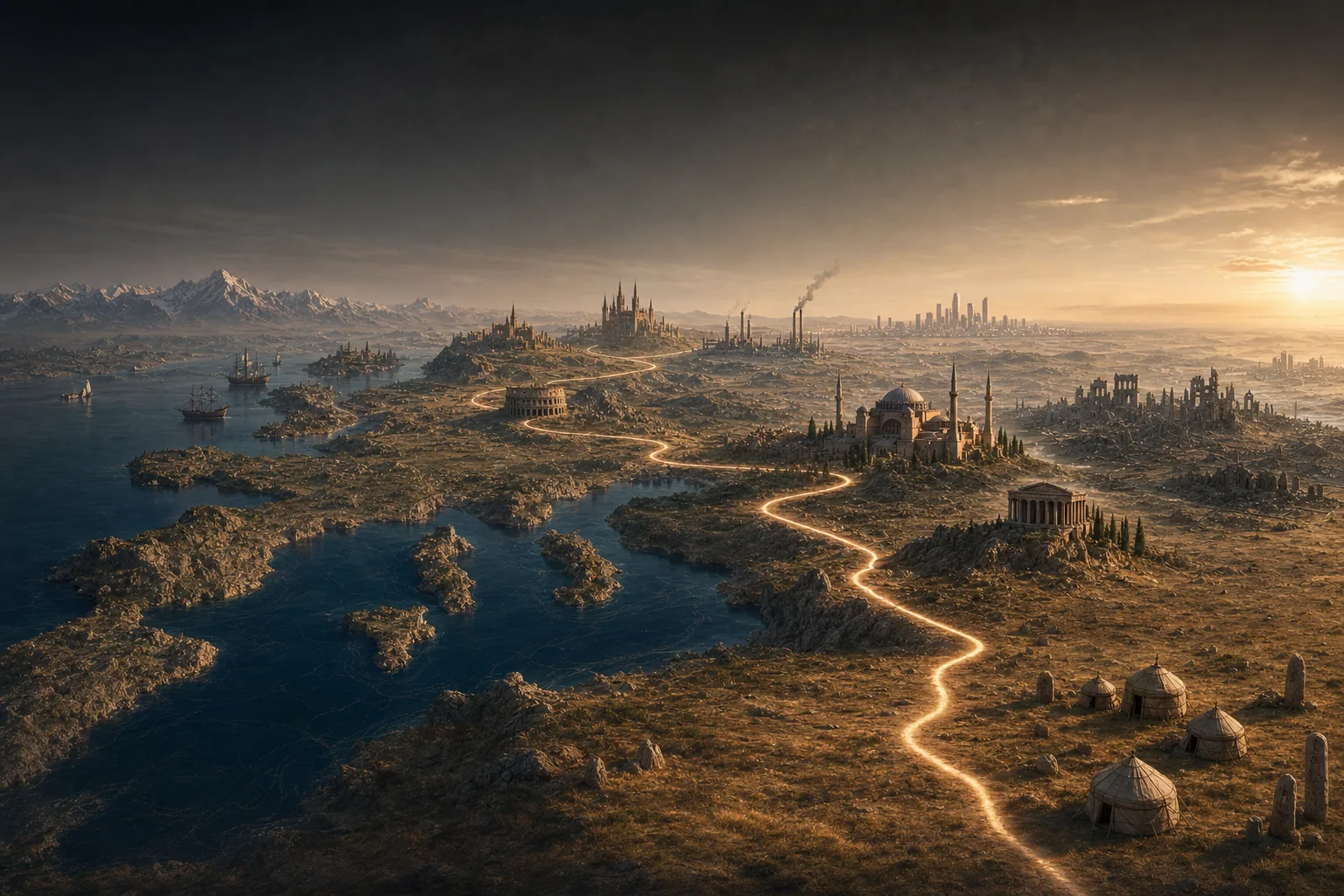
The first European fields were sown by farming communities moving from western Anatolia. They crossed the Aegean, established villages in the Balkans and followed the Danube towards central Europe. Others moved west along Mediterranean coasts. Wheat, barley, sheep and cattle travelled with them, together with the knowledge needed to store a harvest, fire a pot and cultivate the same ground again. Clearings opened within woodland for fields and pasture; grain stores supported denser settlements. Established river and forest communities traded with the villages, joined households and adopted selected practices. By the time riders appeared on the eastern plains, farming had already remade Europe’s landscape, diet and population.
023300–2000 BCThe Pontic Steppe
Origins
The Steppe Comes West
Mobile, armed and patrilineal communities from the Pontic steppe transformed Europe’s population and inheritance.
Around 3000 BC, people from the grasslands north of the Black Sea moved west in large numbers. Herds and ox-drawn wagons carried households across the lower Danube; widespread horse-based mobility came centuries later. Ancient DNA reveals the scale: sampled Corded Ware communities in Germany derived about three quarters of their ancestry from Yamnaya-related populations. Burial mounds fixed paternal lines to the landscape, while weapons and male-biased migration reordered power and descent. Speech travelled with kinship, marriage and command. From the lower Dnipro to central Europe and Iberia, steppe migration created new populations and helped Indo-European languages and inherited religious traditions spread.
032500–500 BCThe Nordic Seas
Ships, Amber and the Northern Sun
Bronze Europe
Bronze tied the Nordic world to mines, ports and trading communities far beyond the Baltic.
A bronze sword buried in Scandinavia began as ore somewhere else. Copper and tin rarely lay near one another, so every axe, razor and ornament depended on miners, sailors, traders and metalworkers spread across great distances. Copper moved north from the Alps, Wales and more distant sources; Baltic amber travelled south towards the Aegean. The Nordic Bronze Age grew inside this traffic. Longhouses and burial mounds overlooked busy waterways, while rock carvings filled Scandinavian stone with ships, crews and warriors. Chiefs turned imported metal into gifts, weapons and ceremony. Command of the sea routes became a source of authority at home.
04800–146 BCThe Athenian Acropolis
The Polis
Greece and the Citizen
The Greek polis made government something citizens could argue about in public.
Politics in a Greek polis happened at shouting distance. Citizens met in assemblies, sat on juries and fought beside men whose proposals they had just opposed. In Athens, speakers persuaded the assembly, magistrates faced scrutiny and large citizen juries decided public cases. Sparta, Corinth and hundreds of smaller cities organised power in their own ways, turning the Greek world into a field of political experiments. Resistance to Persia joined civic freedom to military survival. Historians recorded the choices of statesmen; philosophers asked which constitution formed the best citizens. Europe inherited from the polis a durable question: who should rule, and by what right?
05509 BC–AD 212Rome and the Imperial Roads
One Political World
Rome Gathers Europe
Rome made conquest durable by giving provincial communities a place within the empire.
Roman legions conquered the Mediterranean; roads, cities and citizenship made the conquests hold. Rome recruited provincial elites, preserved useful local customs and gave municipal councils responsibility for taxes and order. A notable in Gaul or Spain could govern his city, enter imperial service and make Rome his political world. Soldiers, merchants and families carried Latin and Roman law far beyond Italy. Each extension of citizenship turned former subjects into participants in the imperial system. In AD 212, Caracalla granted the Roman name to almost every free inhabitant of the empire. A city on the Tiber had gathered much of Europe into one legal order.
06312–565Constantinople
The Consecrated City
The Empire Takes the Cross
Christian faith entered Roman government while Constantinople became the centre of a renewed Christian Rome.
Constantine’s victory opened Roman law, money and monumental space to the Christian church. Emperors summoned councils; bishops defined a creed able to judge the ruler who enforced it. On the Bosporus, Constantinople grew from a new residence into a fortified capital containing court, Senate, cathedral, harbours and archives. When the western imperial office disappeared, the Roman state remained here. Justinian gathered Roman law, raised Hagia Sophia and recovered Mediterranean provinces. By 565, Christian kingship, a defensible European capital and the institutions of Rome had been bound into an imperial order built to endure.
07500–1000Aachen
A New Commonwealth
Europe Reborn
After Rome’s western collapse, kingdoms and churches slowly assembled a new Christian Europe.
New kingdoms rose among the remains of western Rome. Their rulers borrowed Roman titles, employed Latin churchmen and founded monasteries that preserved books, trained officials and cleared land. The Franks joined conquest, conversion and government; on Christmas Day 800, Charlemagne received an imperial crown in Rome. Missionaries and royal marriages then carried Christianity beyond the old frontier. Scandinavians, Bohemians, Poles, Croats and Magyars entered the Latin Church, while Kyiv received its Christianity from Constantinople. Courts, bishoprics and monasteries connected rulers across long distances. By the year 1000, Latin west and Greek east formed two related worlds with a shared Christian inheritance.
081049–1122Canossa and Worms
Power Divides
The Papal Revolution
The quarrel over bishops divided spiritual investiture from temporal government without removing either power from the Christian order.
In the winter of 1077, Henry IV reached Canossa before German princes could assemble under papal judgment. Gregory VII absolved a penitent king without deciding the kingship, and civil war continued. Their quarrel concerned bishops who carried sacramental office, landed regalia, justice and royal service in one person. Reformers claimed canonical election and spiritual investiture for the Church; rulers defended the government attached to episcopal lands. At Worms in 1122, reciprocal promises separated ring and staff from the sceptre while preserving royal presence and influence. Papal and imperial courts remained inside one Christian world as organised jurisdictions that neither side could absorb.
091000–1300Bologna and the University
The Associational West
A Society Beyond Kin
Medieval Europeans gave monasteries, guilds, communes and universities legal lives that outlasted their founders.
A monastery could hold land centuries after its founders were dead. A guild could elect officers, fine a member and support the household of a deceased craftsman. Communes, cathedral chapters and universities acquired the same durable character. Members swore oaths, kept records, held common property and settled disputes under written rules. Canon lawyers gave these bodies a legal personality distinct from any one member. The idea travelled easily because it solved practical problems: property survived succession, obligations became enforceable and collective decisions bound future officeholders. Medieval Europe filled with self-governing institutions whose lives exceeded those of the people who created them.
10950–1350The Fairs of Champagne
Trust at a Distance
The Medieval Commercial Revolution
Medieval merchants developed ways to make promises credible far from home.
At the fairs of Champagne, an Italian merchant could buy Flemish cloth with money that existed only as an entry in a ledger. Trade on this scale required promises that survived distance. Notaries recorded partnerships, merchant courts delivered quick judgments and bills of exchange moved credit without moving heavy coin. Ports and rulers granted foreign merchants privileges because traffic produced customs revenue. Regular fairs gave strangers known dates and places to settle accounts. From Genoa to Bruges, documents joined markets governed by different laws and currencies. The oceanic ventures of later centuries would rely on commercial habits first tested in these fairs, ports and counting houses.
111150–1500Lübeck and the Baltic
Cities Without a State
The Hanseatic North
Baltic and North Sea towns protected their trade by acting together while guarding their independence.
Merchants from Lübeck, Hamburg and other northern towns built the Hanseatic League from privileges, warehouses and repeated meetings. Fish from Norway, grain from Prussia, Russian wax and Flemish cloth passed through their hands. Four great foreign enclaves secured places for Hanseatic merchants in London, Bruges, Bergen and Novgorod. The league had no king, treasury or permanent capital. Its strength came from coordinated action: towns closed markets, imposed boycotts and armed fleets when trade was threatened. Each city decided when to take part, preserving the independence that made cooperation valuable. For centuries, northern rulers had to negotiate with cities acting as a collective power.
12962–1806The Imperial Constitution
The Holy Roman Empire
The Empire of Many Liberties
Negotiated rights held the many jurisdictions of central Europe inside one imperial order.
Central Europe lived for more than eight centuries inside the Holy Roman Empire. An elected emperor governed alongside princes, bishops, free cities, knights and village communities, each holding rights acquired at different moments. The map became a mosaic because jurisdiction followed inheritance, privilege and custom. Imperial diets gathered the estates to approve taxes and settle common business. After 1495, the Imperial Chamber Court offered a standing forum for disputes that once invited private war. A city could defend its charter and a prince his territory without leaving the realm. Negotiated rights gave the empire its durability and made legal pluralism a central European political tradition.
13711–1699Vienna and the Eastern Frontier
Defence and Recovery
The Frontiers Hold
Centuries of war around Iberia, the Balkans and the Mediterranean shaped Europe’s southern and eastern edges.
For centuries, Europe’s southern and eastern frontiers were made by siege, settlement and counterattack. Christian kingdoms advanced through Iberia until Granada surrendered in 1492. Turkish conquest in Anatolia helped provoke the crusades; Ottoman armies then took Constantinople, crossed the Balkans and twice reached Vienna. Mediterranean powers built galley fleets, island bases and chains of coastal forts. The Habsburgs organised a permanent military frontier through Hungary and Croatia, supporting garrisons with taxes raised far inland. Karlowitz shifted the frontier south-east in 1699. These long wars turned border defence into a European enterprise and forced states to command men, money and supplies on a new scale.
141415–1700Lisbon and the Atlantic
The Oceanic Turn
Europe Turns Seaward
Armed ocean-going ships allowed European states to operate far beyond their own coasts.
Portugal captured Ceuta in 1415 and spent the next decades extending its voyages down the African coast. Each expedition added winds, currents and harbours to the charts carried home. Mariners adapted Mediterranean navigation and shipbuilding to Atlantic conditions; cannon and royal finance kept vessels at sea and protected fortified ports. Portuguese ships rounded Africa and reached India. Spanish expeditions crossed the Atlantic, followed by Dutch, English and French rivals. Pilots and brokers turned landfalls into working routes; forts and contracts made the routes durable. Ocean-going ships had enlarged the reach of the European state to thousands of miles beyond its own shores.
151517–1648Wittenberg
Christendom Fractures
The Reformation
The Reformation divided western Christendom and made confessional allegiance a permanent concern of government.
Luther began with an argument about indulgences and church authority. Print turned it into a European crisis. Pamphlets crossed borders, vernacular Bibles entered homes and rulers discovered that reform could place churches and property under territorial control. Catholic renewal answered with seminaries, schools, new religious orders and missions. Confessional loyalty reached into worship, marriage and education; rulers expected subjects to share the faith of the state. Revolts and wars followed as rival churches hardened their institutions. Augsburg and Westphalia ended the project of restoring a single western Christendom. European governments learned to conduct politics across permanent religious division.
161526–1918Vienna and the Crownlands
Many Peoples, One Crown
Habsburg Europe
The Habsburgs bound historic kingdoms and their different peoples to a common dynasty.
The Habsburg monarchy was assembled one inheritance and marriage at a time. After 1526, the Austrian lands, Bohemia and Hungary shared a dynasty and an Ottoman frontier. Each crownland kept its laws, diet and privileges. Vienna supplied the court, diplomatic centre and much of the army; provincial elites supplied taxes, recruits and local government through recurring bargains. The Compromise of 1867 created separate Austrian and Hungarian governments under one ruler. Czechs, Croats, Poles, Romanians and Ukrainians organised national movements inside the dynastic framework. Millions carried local, national, dynastic and imperial loyalties together until war destroyed the monarchy in 1918.
171543–1700The Republic of Letters
Knowledge Under Inspection
The Scientific Revolution
European scholars built institutions that exposed claims about nature to observation, test and criticism.
Copernicus rearranged the heavens, Vesalius opened bodies, Galileo pointed new instruments at the sky and Newton gave motion a mathematical language. Their work travelled through printers, universities, workshops, observatories and courts competing for useful knowledge. Scientific societies in London, Paris and elsewhere asked members to describe methods closely enough for another observer to repeat them. Journals fixed claims in print and correspondence carried criticism across borders. A scholar blocked in one city could find a publisher in another. Evidence acquired a public career: results travelled, drew attack, survived replication or yielded to correction. Knowledge became a cumulative European enterprise.
181572–1713Amsterdam
Commerce, Credit and Toleration
The Dutch Republic
The Dutch Republic turned the independence of its cities into an unlikely source of global power.
The Dutch Republic rose as a loose federation of provinces crowded with self-governing towns. Amsterdam’s merchants built shipping networks from the Baltic to Asia. The state borrowed at low rates, investors traded shares and marine risk, and the exchange concentrated news from every market. Printers sold maps, books and arguments across Europe. Leiden’s university drew scholars, while refugees brought capital, skills and commercial contacts into Dutch cities. Provincial rivalry kept power dispersed; common danger made the towns cooperate through the States General. Foreign visitors found a country where civic independence, religious latitude and relentless commerce reinforced one another—and made a small republic a global power.
191680–1789The European Public
Public Opinion
The Enlightenment
A growing reading public began to judge laws, rulers and customs as matters open to argument.
The Enlightenment gathered in London coffeehouses, Parisian salons, Masonic lodges, theatres and provincial reading societies. Newspapers and journals carried arguments from one room to another. Readers compared English liberties, Dutch commerce, French manners and the reforms of central European rulers. Edinburgh philosophers examined sympathy, history and markets; Parisian writers built reputations large enough to trouble ministers. Publishers learned that controversy sold. Reviews made books answerable to strangers, and public opinion became a force courts tried to measure and manage. A law or custom once defended by age and authority now faced a new test: could it survive criticism in print?
201700–1850Manchester
The Great Acceleration
Rivalry and the Industrial Breakthrough
In Britain, coal, machinery and commercial skill pushed production beyond the limits of muscle and water.
Britain’s industrial breakthrough joined expensive labour, accessible coal, skilled mechanics, credit and large markets. Mine owners bought engines to pump water from deep shafts. Textile manufacturers adapted machinery to spin and weave at speeds no workshop could match. Steam power escaped the mine and entered factories, ships and railways; each application created demand for stronger iron, better tools and more coal. Manchester drew raw cotton through Liverpool and sent finished cloth into world markets. By 1850, factory bells and railway timetables governed the working day in growing towns. Industrial production had given European states a new kind of economic and military power.
211802–1914Paris and the Railway Age
Continental Ascendancy
The European World
Industrial power allowed European states to command trade routes, territory and capital on a global scale.
A traveller leaving Europe in 1900 encountered European power in shipping schedules, banks, colonial offices, railway stations and telegraph cables. Steam compressed ocean journeys; railways carried troops and goods inland; industrial supply chains kept imperial armies equipped far from home. London and Paris directed capital towards mines, ports and plantations on other continents. Shipping companies and submarine cables bound those investments to European markets and ministries. By 1914, European states controlled most imperial territory, the leading sea routes and a commanding share of overseas finance. Industrial capacity had become geopolitical command, placing Europe at the centre of a world system.
221914–1945Verdun
The Catastrophe
The European Civil War
Two world wars turned Europe’s industrial and administrative strength against its own societies.
Europe went to war in 1914 with railway schedules, mass armies and confident promises of victory. Four years of artillery, trenches and blockade killed millions and broke the German, Habsburg, Russian and Ottoman empires. The peace drew new borders without creating a stable order. Fascists, Nazis and Soviet communists then joined radio, bureaucracy and mass politics to systems of control beyond the reach of older tyrannies. The next war consumed cities and culminated in Germany’s systematic murder of Europe’s Jews. In 1945, the continent that had commanded the world lay ruined and divided between American and Soviet power.
231945–1989Brussels and Berlin
Recovery
The Continent Rebuilt
Western Europe recovered by tying national economies and old rivals into a shared legal order.
Western Europe rebuilt through factories, trade and security guaranteed by the United States. France and West Germany placed coal and steel under a common authority, turning the raw materials of war into subjects of routine administration. Treaties widened the arrangement into a common market; courts and regulations made each bargain part of a permanent legal order. Growth financed welfare states and gave democratic politics a material foundation. Across the Iron Curtain, Soviet power held a different European system in place. In 1989, strikes, demonstrations and political courage from Gdańsk to Prague broke that division and opened the road to continental reunification.
241989–PRESENTKyiv and Europe’s Eastern Frontier
The Unfinished Journey
Europe Returns
Reunification enlarged Europe’s institutions; the war in Ukraine now tests their capacity for common action.
After 1989, countries from the Baltic to the Balkans entered institutions once confined to Western Europe. Roads and railways crossed borders sealed within living memory; students, workers and capital followed. European Union membership carried law and markets eastward. NATO extended an American-backed defence guarantee across the same region. Ukraine held neither membership when Russia launched its full-scale invasion in 2022. European governments answered with sanctions, weapons and new defence budgets, while the United States remained central to the military effort. The unfinished journey now turns on Europe’s ability to convert common interests into decisions, resources and sustained power.