EUROCENTRIC

01 · 7000–3300 BC

The First Farmers

Farming came to Europe with people who carried seed, animals and knowledge. It bound growing populations to land, season and stores made to outlast a single generation.

The river before the fields
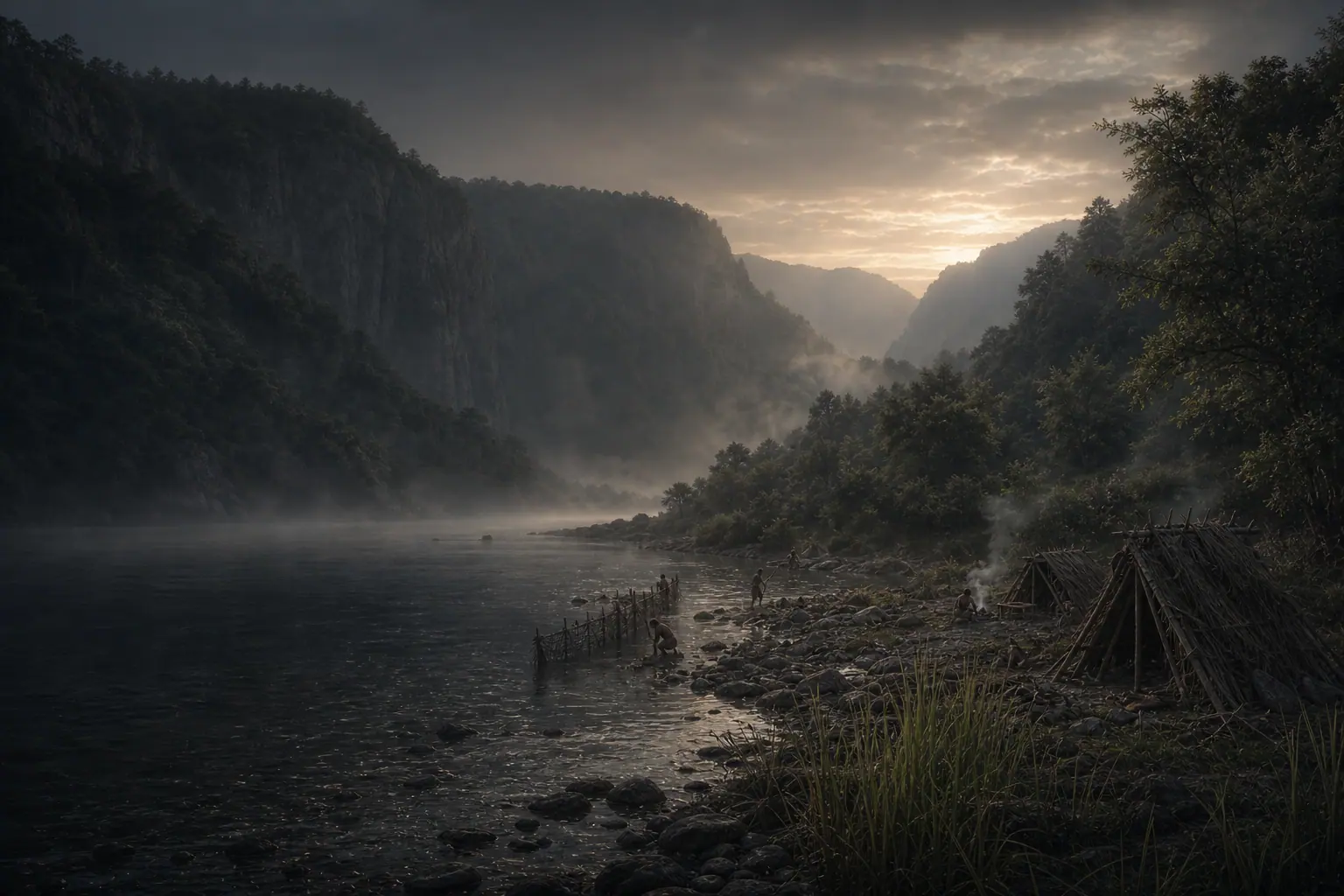
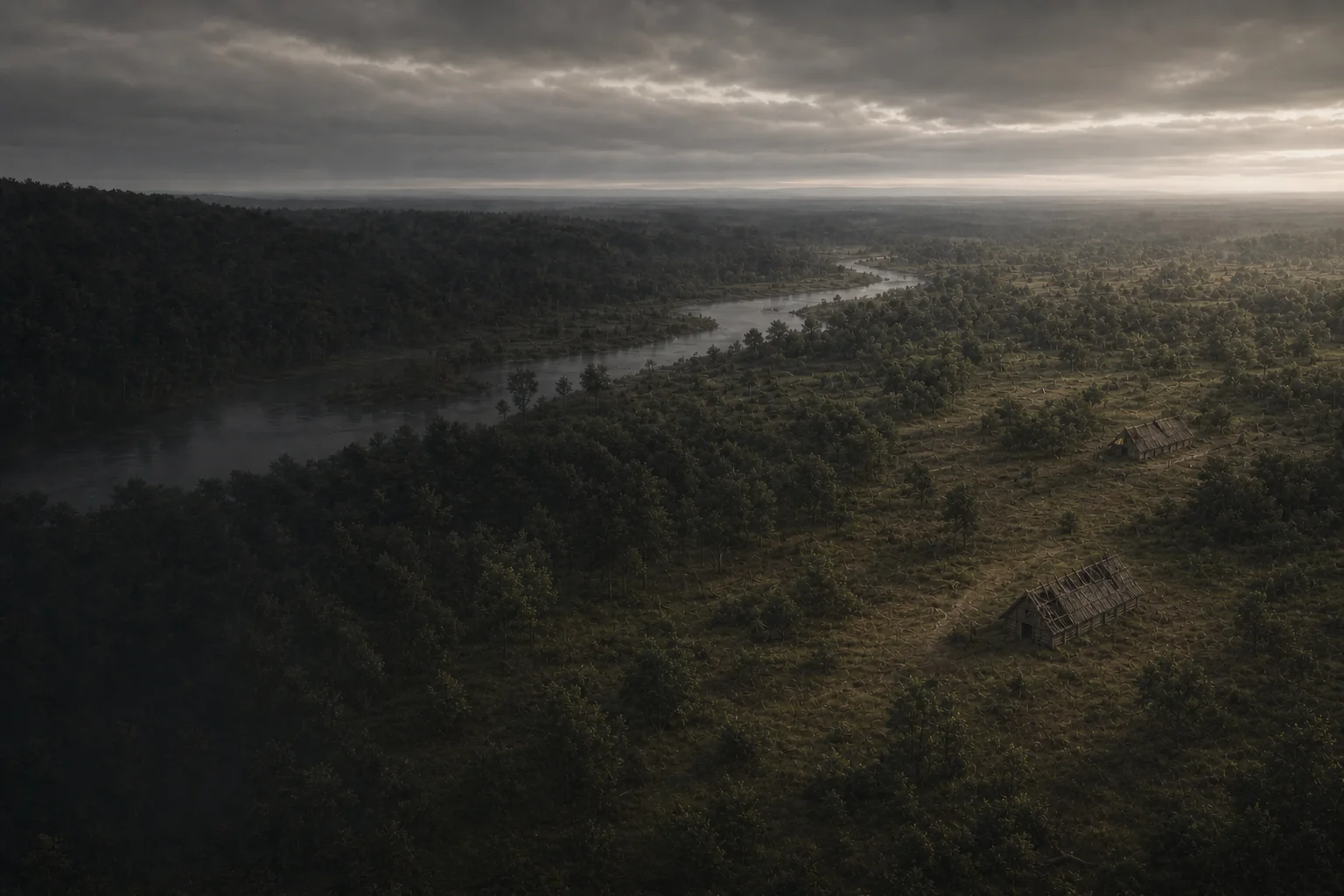
A misty Danube gorge with fishing weirs and seasonal shelters along the wooded shore.Place, date and surviving record

c. 7000 BCThe Iron Gates

Before the Fields

The river already held a world.

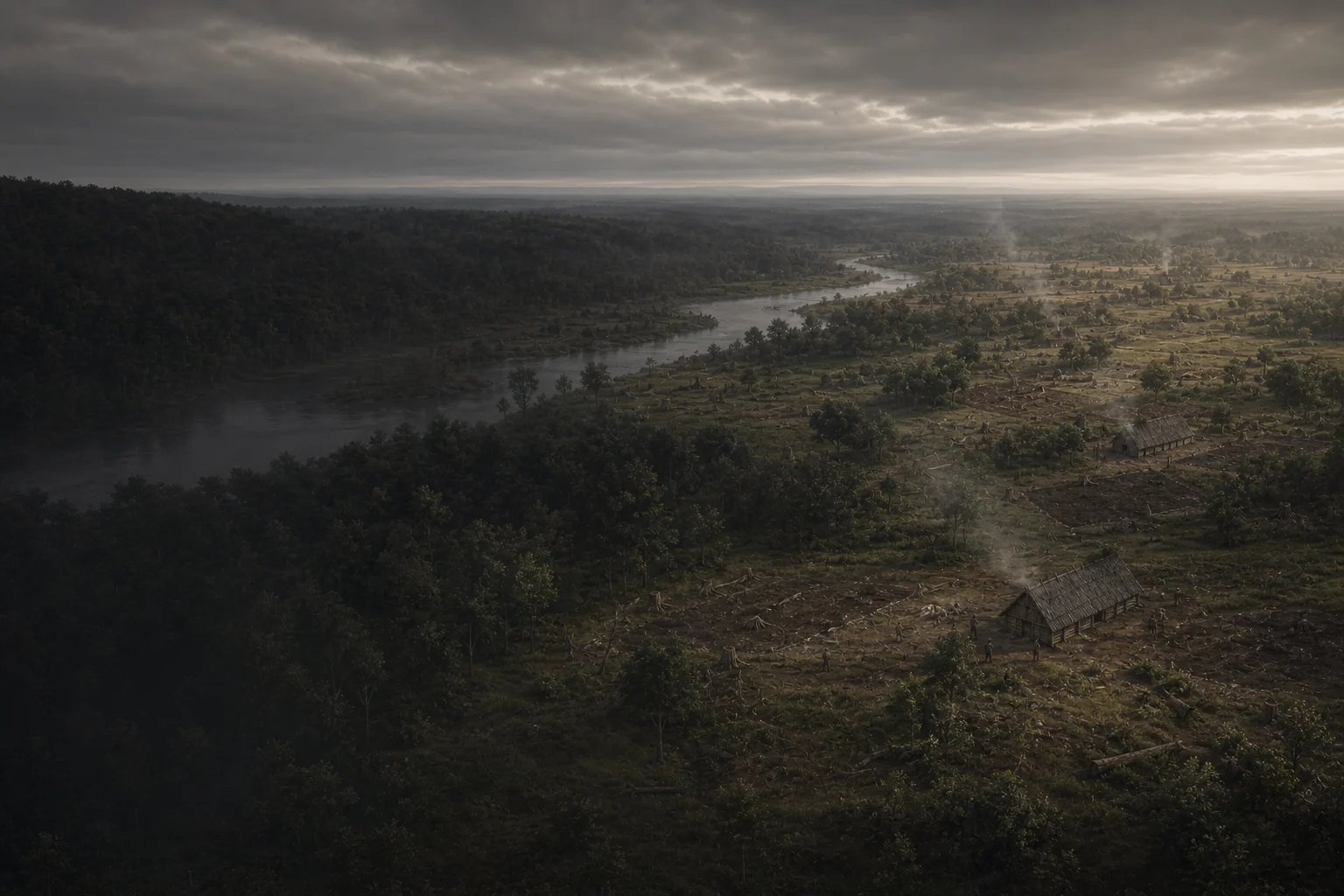
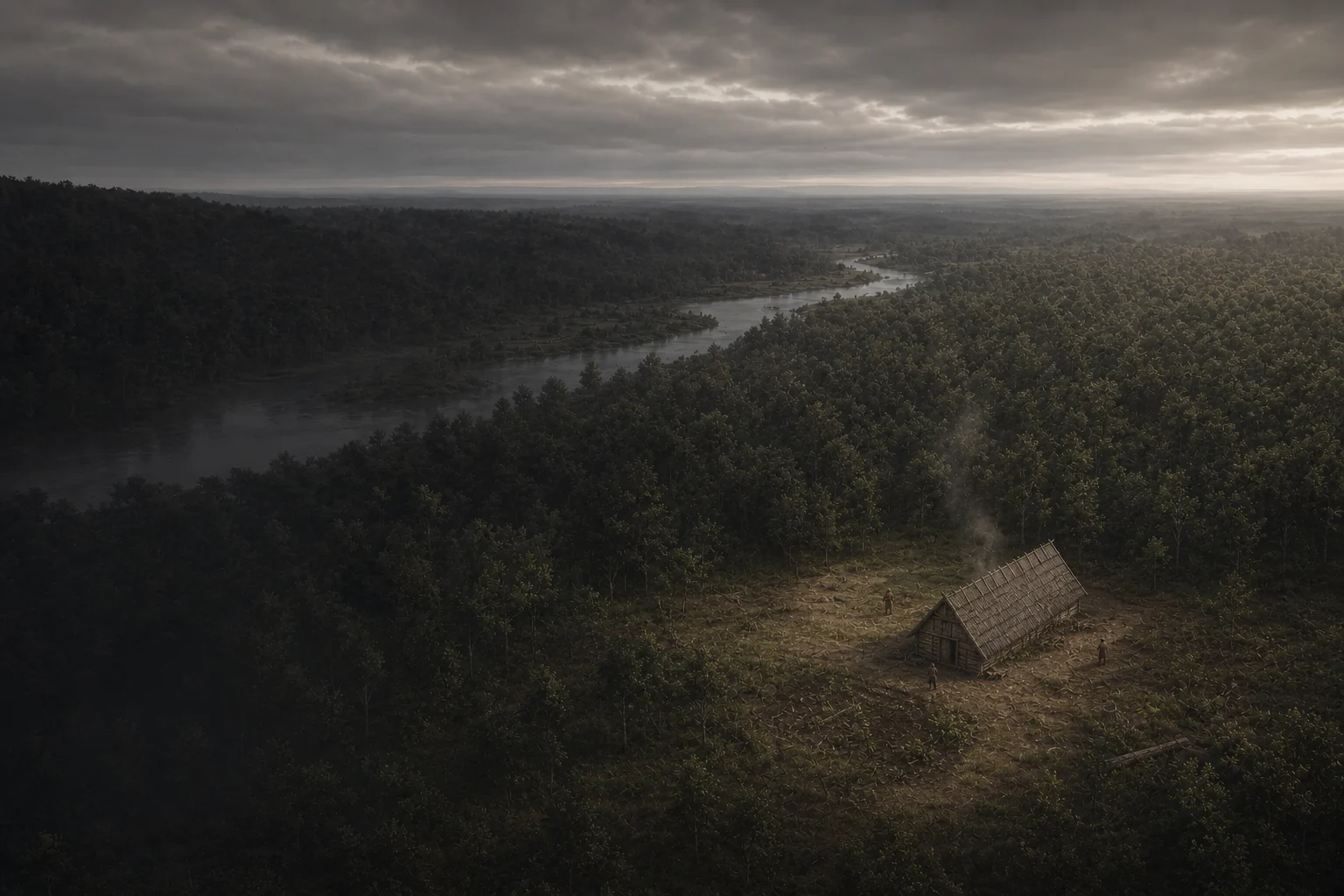
Long before crops reached the Danube, people lived from the gorge’s river and forest. Fishing mattered enormously; hunting, gathered plants and exchange widened the food supply. At Lepenski Vir and nearby sites, substantial buildings, cemeteries and repeated occupation anchored communities to particular stretches of river. People moved to exploit changing resources, then returned to places already dense with memory. Boats connected banks, islands and distant exchange partners more easily than forest paths did.

The first farmers therefore entered an inhabited continent. At the Iron Gates, established river communities had houses, cemeteries, exchange routes and memories attached to place. Farming would not replace an empty wilderness. It would meet societies whose lives were already fitted closely to river, forest and season.

What survived
  • Fish bones, mammal remains and stable isotopes record diets drawn heavily from the Danube and its wooded banks.
  • Buildings, burials and sculpted stones at Lepenski Vir show repeated occupation of a place already dense with memory.

Stephen Shennan (2018)Iain Mathieson et al. (2018)

Turn the river year

Four seasons show how fish, forest foods and movement supported life before local farming.

High water opened channels through the gorge.

  • Migrating fish
  • Fresh greens
  • Waterfowl

Fish runs drew people to narrow channels and repaired weirs.

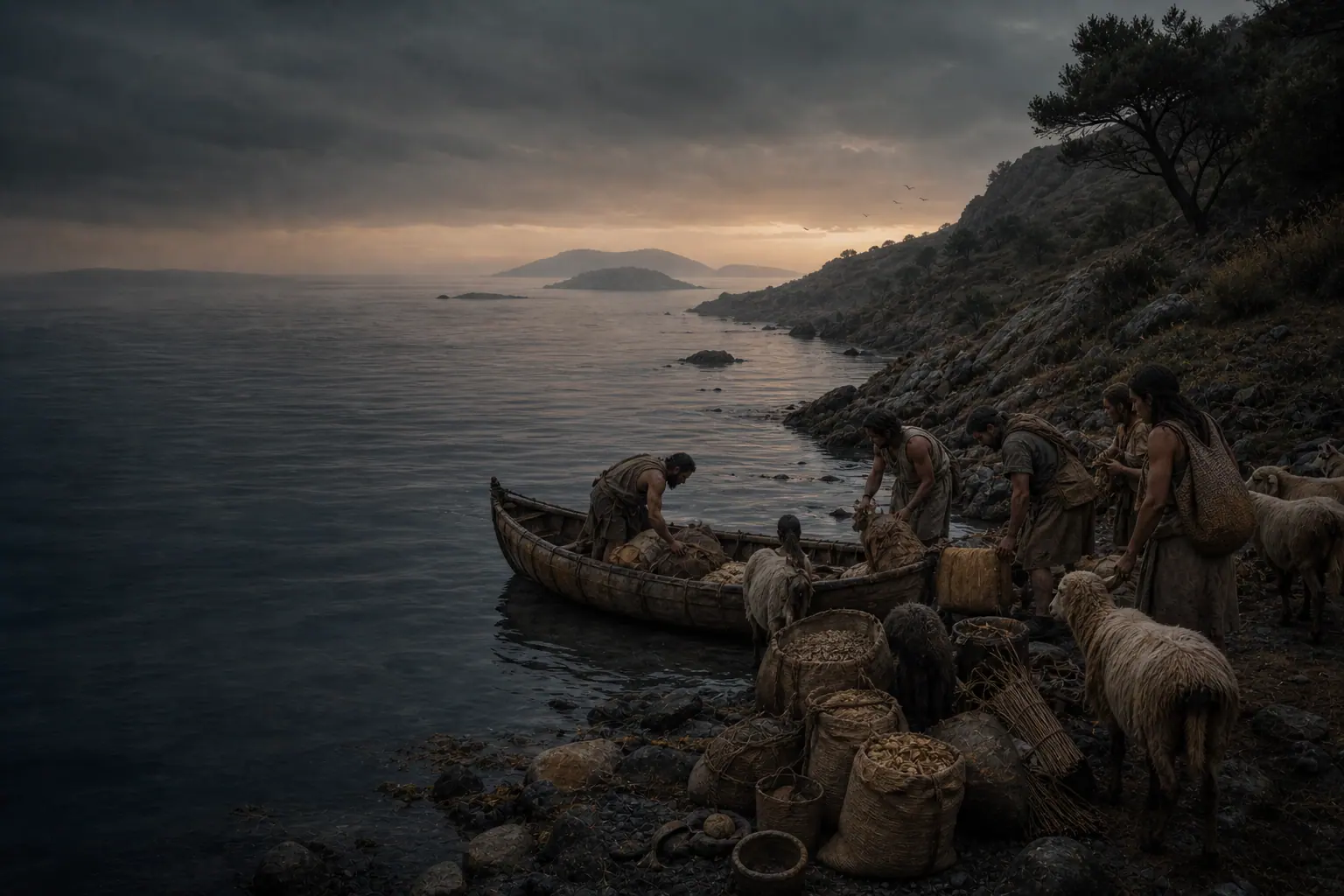
A household loads grain, animals and tools into a small boat on an Aegean shore.Place, date and surviving record

7000–6500 BCAnatolia · The Aegean · Thessaly

A Household Crosses the Sea

The field travelled as a living system.

Communities from western Anatolia carried more than seed. Emmer and einkorn wheat needed knowledge of soil and timing. Sheep and goats needed breeding, fodder and protection. Pottery, grinding stones and storage joined the same system. Children learned its routines by working beside adults, making knowledge portable without writing. Remove one part and the others became harder to sustain.

Ancient DNA shows that farming reached southeastern Europe chiefly through the movement of people whose ancestry traced largely to Anatolian farming populations. Repeated crossings through the Aegean brought people, animals and seed to new shores and into Thessaly. From the Balkans, farming later followed the Danube towards central Europe. Other communities moved west along Mediterranean coasts. The routes differed, but people, plants, animals and learned routines moved together.

What survived
  • Ancient genomes connect southeastern Europe’s first farming populations chiefly to earlier farmers in Anatolia.
  • Domestic wheat, sheep and goats appear with pottery, grinding stones and storage practices along Aegean and Balkan routes.

Iain Mathieson et al. (2018)Stephen Shennan (2018)

Carry the household

Four connected places trace a farming household from western Anatolia through the Aegean to Thessaly and the Danube.

Seed, livestock and practiced routines began the crossing together.

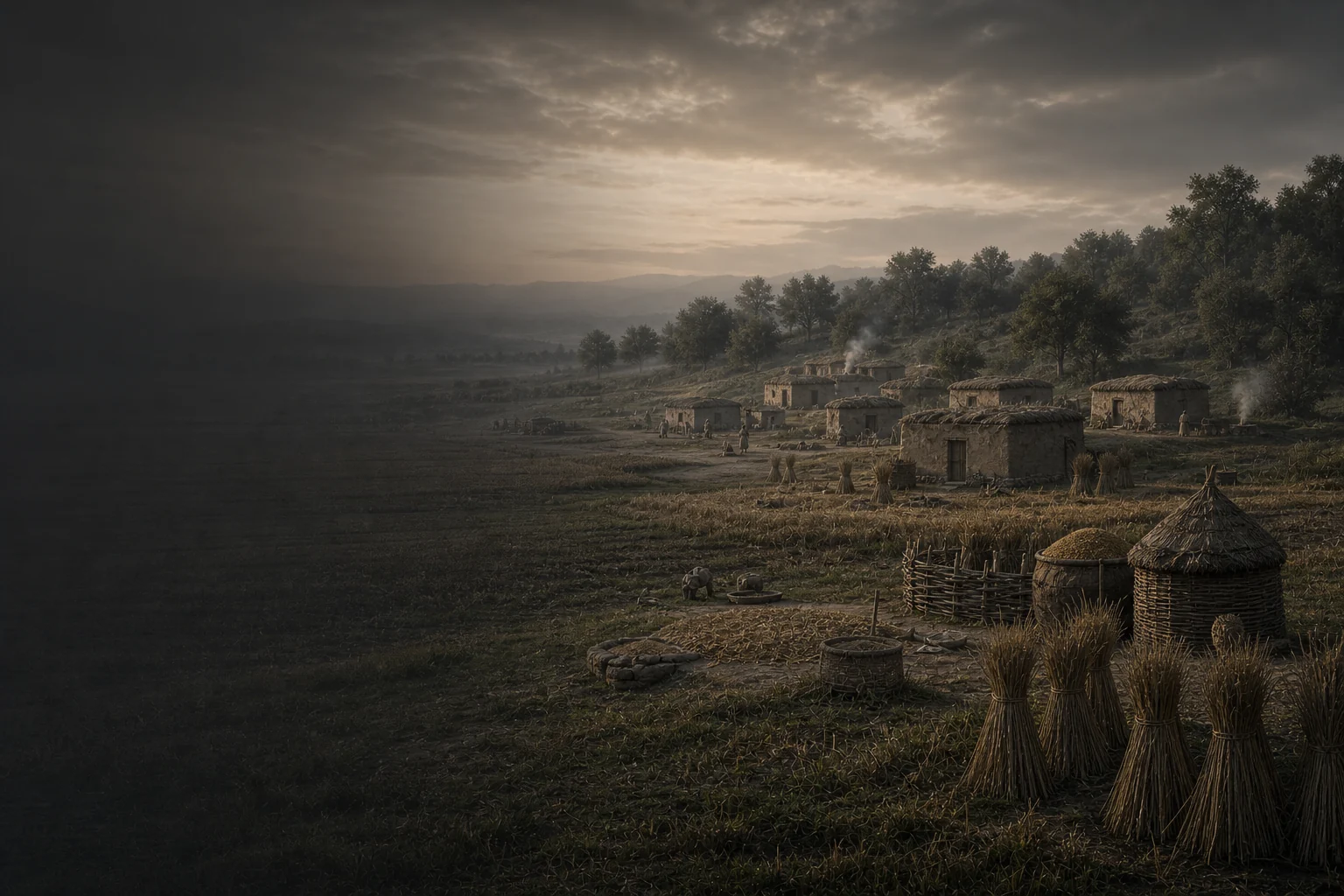
An early Thessalian settlement beside harvested grain plots, baskets, sheaves and protected stores.Place, date and surviving record

6500–6000 BCThessaly

The Harvest
Had to Last

Seed kept for spring could not be eaten in winter.

A field changed the shape of the year. Ground had to be cleared and worked before sowing. Young plants needed protection. Ripe grain had to be cut, dried, threshed and kept away from damp, fire, insects and hungry animals. Livestock spread risk, but they required pasture, water, care at birth and winter fodder. A missed season could not be repaired the following week.

Stored grain answered three different needs. Some fed the household through winter, some covered spoilage and scarcity, and some had to remain untouched for spring sowing. Farther east, Georgian farmers were fermenting grapes in large clay jars by about 6000 BC. Wine residues survive at Shulaveris Gora and Gadachrili Gora. The Georgian qvevri tradition continues this use of clay: large vessels are buried while the wine ferments and ages.

What survived
  • Charred emmer and einkorn grains preserve the crops that entered stores, ovens and spring sowing.
  • Grinding stones, sickle traces, storage pits and burnt house deposits preserve the work between harvest and meal.
  • Organic acids from grape wine, together with grape pollen and skin remains, survive in and around large clay jars from Shulaveris Gora and Gadachrili Gora.

Stephen Shennan (2018)Patrick E. McGovern et al. (2017)UNESCO (2013)

Divide the store

Move shares of one illustrative store between food, reserve and seed; every choice changes what the household can face next.

Food, a buffer and spring seed are all protected.

One store has to answer three different futures.

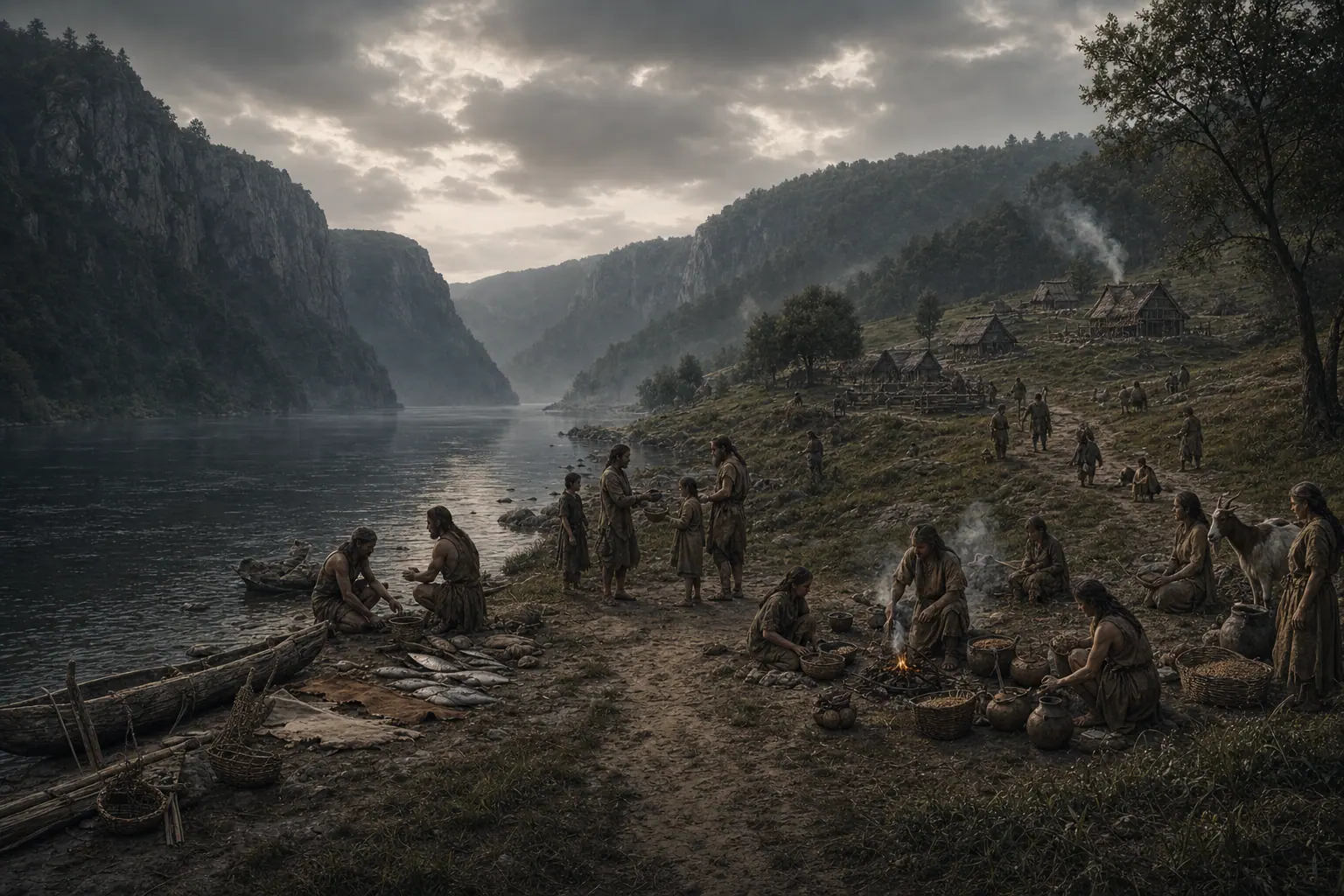
River and farming communities exchange food and objects beside the Danube.Place, date and surviving record

6200–5800 BCThe Iron Gates

At the Iron Gates

Two ways of living entered the same households.

At the Danube gorge, incoming farmers met communities built around river and forest. Fish and hides crossed one way; pottery, grain and domestic animals crossed another. Stone from distant sources already travelled through older river networks, giving newcomers routes they had not created. Some people adopted selected practices without abandoning older ones. Some moved into farming settlements. Some farming households included partners whose ancestry and childhood lay along the river.

The result varied from place to place and generation to generation. Ancient DNA records migration and mixture, while tools and food remains record exchanges that genes alone cannot show. The frontier was neither a clean replacement nor a single peaceful merger. It was a long sequence of encounters in which people, goods and skills travelled at different speeds.

What survived
  • Ancient DNA distinguishes hunter-gatherer-related and Aegean farmer-related ancestry without turning a cemetery into a universal family sequence.
  • Fish bones, domestic animals, cereal remains and pottery show practices crossing the frontier at different speeds.

Iain Mathieson et al. (2018)

Set three records beside one another

Dated archaeological contexts show changing ancestry and subsistence at different Iron Gates places, not a single three-generation pedigree.

Before c. 6200 BCPredominantly Iron Gates hunter-gatherer-related ancestry in sampled individuals.

Fishing, hunting and exchange organised life in long-used settlements along the gorge.

A partially cut-away Neolithic longhouse with older postholes visible in the soil.Place, date and surviving record

5600–4900 BCThe Loess Plains

The House Outlives Its Builders

Timber failed. The place endured.

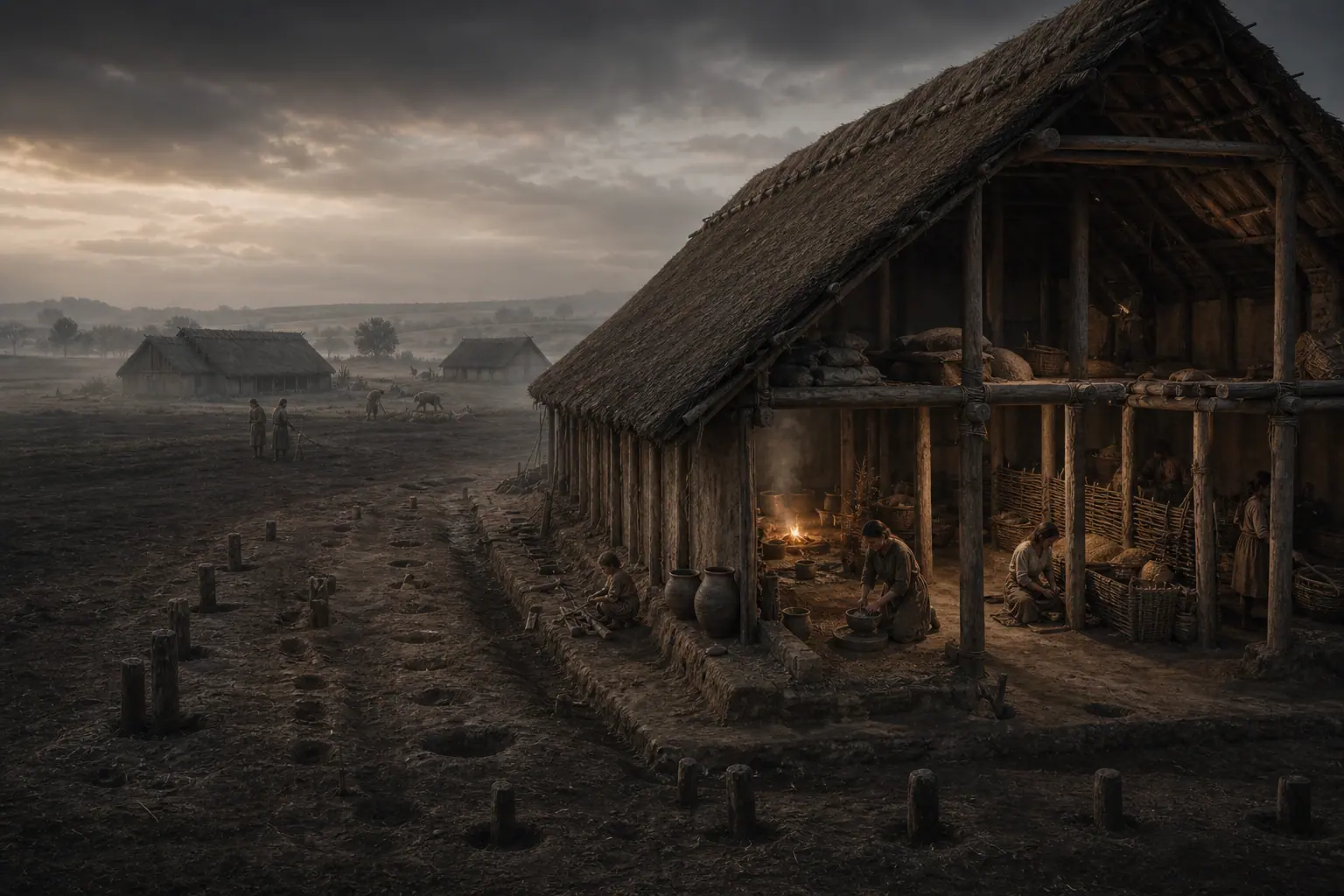
Across the fertile soils of central Europe, longhouses gathered people, tools and stores beneath one roof, with livestock held close around the settlement. Posts rotted and walls were repaired. New buildings rose beside the marks of older ones. Wells, paths and worked ground tied neighbouring houses into a shared place. Cleared soil, stored grain and livestock made one generation’s labour part of the life awaiting the next.

Burials and ancient pedigrees reveal that some communities organised this continuity through strong paternal lines. Women often arrived from other communities, creating connections between settlements. These patterns differed between places, but they show how fixed houses and repeatedly worked fields anchored kinship and obligation to a durable place.

What survived
  • Postholes, wall trenches, wells and repaired floors reveal houses rebuilt beside the footprints of earlier structures.
  • Burials, strontium isotopes and ancient pedigrees reveal kinship, mobility and different local rules of residence.

Maïté Rivollat et al. (2023)Pere Gelabert et al. (2025)

Read the longhouse

Four places in the longhouse connect storage, daily work, repair and earlier buildings.

Stored grain carried one harvest into another season and another round of sowing.

Widely spaced Neolithic longhouses and irregular clearings within a still heavily wooded river plain.Place, date and surviving record

5500–4000 BCThe Danube and the Loess Belt

More Mouths, More Land

A household became a demographic force.

Across many regions, archaeological dates trace a rapid rise in population after farming arrived. Stored harvests, settled childcare and repeated cultivation were likely contributors, while permanent houses concentrated care and work in one place. One longhouse became several. Paths joined neighbouring clearings. Across the Danube corridor and the loess plains, village networks expanded within a few centuries. Along Mediterranean coasts, farming moved through a different chain of shores and islands.

Growth demanded ground. Trees fell for fields, pasture and timber. Radiocarbon dates reveal regional population booms followed by contraction rather than a smooth advance. No single mechanism ended them: harvest failure, disease, conflict and local environmental strain acted in different combinations. Some houses emptied while people, seed and animals established settlements elsewhere. Farming spread through repeated growth, disruption and movement.

What survived
  • Radiocarbon dates rise and fall in regional clusters, tracing population expansion and contraction rather than a smooth advance.
  • Settlement plans, charcoal and pollen record new houses, clearance and later regrowth without yielding exact continent-wide household totals.

Stephen Shennan et al. (2013)Stephen Shennan (2018)

Open the ground

Three reconstructed landscape states move from one clearing to an expanding settlement zone and later local contraction.

A single longhouseContinuous woodland around a small worked opening

A clearing held one household, its animals and a guarded store.

A relief map of Europe, used to compare the spread of fields, herds and settled populations.Place, date and surviving record

4500–3300 BCEurope

A Continent Remade

Fields changed the land. Herds changed the traffic of disease.

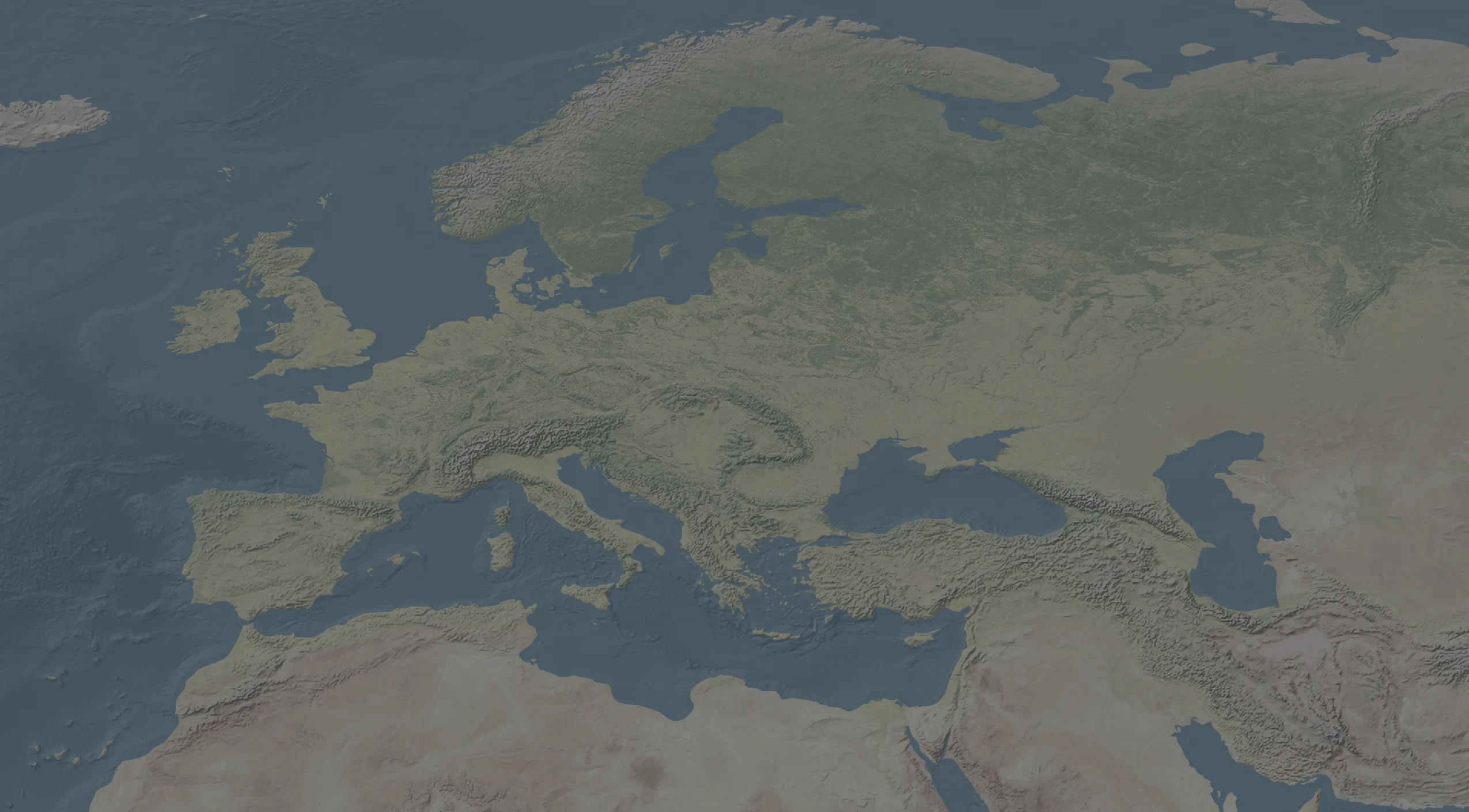
By 3300 BC, fields, herds and permanent houses extended across much of Europe. Farming ancestry had mixed with local populations in different proportions. Pathogens had accompanied humans long before farming, but ancient DNA begins to reveal zoonotic pathogens from about 4500 BC. Their prevalence rose towards 3000 BC alongside widespread livestock keeping, then increased further during later pastoralist migrations. Grain-heavy diets and repeated labour also left marks on teeth and bone.

Across the ten millennia that include this transformation, ancient genomes record strong directional selection at hundreds of variants. The first farmers did not possess one fixed European appearance: pigmentation-related variants changed in frequency across later millennia, just as ancestry continued to change. Some combinations of variants that now correlate with measures of cognitive performance also changed in frequency. Their effects in prehistoric lives are unknown, and they do not show that farming raised human intelligence.

The languages of these farming communities are lost. Names they gave rivers, seasons and crops disappeared or survive beyond recognition. One recent language-tree model places an earlier Indo-European expansion among farming populations south of the Caucasus; ancient DNA associates many branches later spoken in Europe with populations moving west from the steppe after 3300 BC. Those steppe migrants entered a continent already organised around fields, herds and long-lived settlements.

What survived
  • Human, animal and pathogen genomes preserve ancestry change, selection and the later rise of several zoonotic infections.
  • Teeth and bone preserve diet, labour and disease; pollen, charcoal and settlement remains preserve altered land.
  • No inscription records the languages of Europe’s first farmers.

Iain Mathieson et al. (2018)Martin Sikora et al. (2025)Ali Akbari et al. (2026)Paul Heggarty et al. (2023)Iosif Lazaridis et al. (2025)

Set the two landscapes against each other

A split view compares a river world around 7000 BC with a farming landscape around 4500 BC; four themes identify what changed and what the evidence cannot recover.

Seasonal ranges became mosaics of field, pasture and managed woodland.

Archaeology · ancient DNA · palaeopathology

What survived

  1. Stephen ShennanThe First Farmers of Europe: An Evolutionary PerspectiveCambridge University Press, 2018
  2. Iain Mathieson et al.The genomic history of southeastern EuropeNature 555, 2018
  3. Patrick E. McGovern et al.Early Neolithic wine of Georgia in the South CaucasusProceedings of the National Academy of Sciences 114, 2017
  4. UNESCOAncient Georgian traditional Qvevri wine-making methodRepresentative List of the Intangible Cultural Heritage of Humanity, 2013
  5. Stephen Shennan et al.Regional population collapse followed initial agriculture booms in mid-Holocene EuropeNature Communications 4, 2013
  6. Maïté Rivollat et al.Extensive pedigrees reveal the social organization of a Neolithic communityNature 620, 2023
  7. Pere Gelabert et al.Social and genetic diversity in first farmers of central EuropeNature Human Behaviour 9, 53–64, 2025
  8. Martin Sikora et al.The spatiotemporal distribution of human pathogens in ancient EurasiaNature 643, 2025
  9. Ali Akbari et al.Ancient DNA reveals pervasive directional selection across West EurasiaNature 654, 2026
  10. Paul Heggarty et al.Language trees with sampled ancestors support a hybrid model for the origin of Indo-European languagesScience 381, 2023
  11. Iosif Lazaridis et al.The genetic origin of the Indo-EuropeansNature 639, 132–142, 2025